

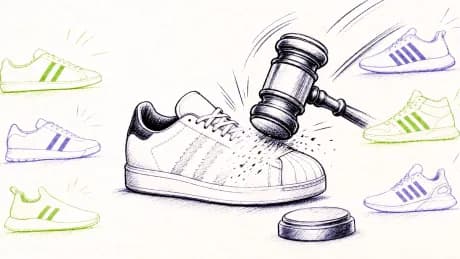
Stripe Wars: Why Adidas Can't Claim the Whole Pattern
Adidas's three parallel stripes are among the best known brand symbols in the world. They appear on shoes, jerseys, and tracksuits across nearly every sport, and they represent billions of dollars in brand equity. But as Adidas has tried to stretch that symbol into something closer to a monopoly on "stripe like" designs in fashion, courts and tribunals have begun to push back.
A New Flashpoint: Steve Madden's Two Stripe Designs
On May 21, 2025, Steve Madden filed a declaratory judgment lawsuit against Adidas in the Eastern District of New York, asking the court to confirm that two of its sneakers, the Viento and the Janos, do not infringe Adidas's three stripe mark. According to Steve Madden's complaint, the Viento uses two non parallel, diverging bands and the Janos uses two bands forming a stylized "K," and neither design incorporates three parallel stripes or any Adidas branding.
The case didn't arise in a vacuum. Earlier that month, Adidas sent a cease-and-desist letter demanding that Steve Madden halt sales of at least one of the two-stripe designs and also opposed Steve Madden's K-design application at the USPTO. In response, Steve Madden's pleading accuses Adidas of "illegal and anticompetitive efforts to monopolize common design features in the fashion industry" and states bluntly that "Adidas does not own all stripes" on footwear. Those statements are drawn directly from the complaint filed, not from press summaries, which matters if you intend to quote them.
A Long History of Stripe Enforcement
The Steve Madden dispute is just the latest chapter in a long enforcement campaign. Public reporting and court records show that Adidas has brought hundreds of enforcement actions, dozens of lawsuits, and many oppositions tied to its three stripe branding over the past few decades. Past targets have ranged from high-fashion houses such as Thom Browne to mass-market retailers, golf organizations, and even political movements, reflecting a deliberate strategy to treat a wide variety of stripe configurations as potential infringements.
At least some of those efforts have succeeded. In the Payless litigation, for example, a federal jury in Oregon awarded Adidas roughly 305 million dollars in damages based on dozens of shoe designs that used two and four-stripe patterns the jury found confusingly similar to Adidas's mark. But more recent cases and registry decisions suggest that courts are increasingly skeptical when Adidas's theory of infringement strays too far from the specific three stripe trade dress consumers associate with the brand.
Thom Browne and the U.S. Jury That Drew a Line.
The U.S. litigation against Thom Browne became a key test of how far those rights extend. In adidas America, Inc. v. Thom Browne, Inc., a Southern District of New York jury found in 2023 that Thom Browne's four bar designs did not infringe or dilute Adidas's three stripe mark. Commentary on the case emphasizes that the jury considered both the number and presentation of the stripes and the different positioning of the brands in the marketplace, including their price points and target consumers.
Adidas has appealed that decision, but even at the trial court level, it stands as an example of a U.S. factfinder refusing to convert a famous three-stripe mark into a blanket claim over "any series of parallel bars" on clothing. For counsel advising fashion brands, the verdict is a useful reminder that likelihood of confusion analysis remains context specific: more stripes, different placements, and different customers still matter.
The UK Court of Appeal: Clarity, Precision, and Position Marks.
The most dramatic recent setback for Adidas's broader stripe strategy came in the United Kingdom. In proceedings initiated by Thom Browne entities, the High Court in November 2024 invalidated a set of Adidas three stripe position marks on the ground that they did not meet the statutory requirement of clarity and precision. Adidas appealed, but on 23 October 2025 the UK Court of Appeal dismissed that appeal and upheld invalidity for six of the registrations.
The Court of Appeal agreed that the combination of the visual depictions and written descriptions allowed too much variation in how the stripes might appear, length, placement, orientation, and coverage on the garment, so the registrations did not represent a single, clearly defined sign. That reasoning aligns with EU case law on position marks and reinforces a basic point: the register is not meant to capture an entire aesthetic "idea" such as "three stripes somewhere on clothing," but rather a specific sign that third parties can recognize and avoid.
What Trademark Law Actually Protects.
None of this means Adidas has weak rights in its core three-stripe trade dress. Courts and tribunals continue to recognize that simple geometric marks can acquire distinctiveness and, when used consistently, can serve as powerful indicators of source. For well-known marks, anti-dilution doctrines also provide tools to stop uses that blur or tarnish their distinctiveness, even in the absence of direct confusion.
The tension arises when a brand owner treats a valid registration as conferring control over an entire category of common design elements. Trademark law protects specific marks, as depicted and described in the register and as used in commerce, for identified goods and services. It does not give any single company ownership of "all stripes," "all color blocking," or "all minimalist shapes" in each sector, particularly when those elements are widely used in the industry as decorative features.
Why Steve Madden's Case Matters for Fashion Brands.
Steve Madden's declaratory judgment suit is still at an early stage, but the questions it raises are framed in a way that many fashion brands will recognize. When a complaint insists that a two-stripe, non-parallel design infringes a three-stripe mark, the real issue is whether consumers are likely to see that design as a badge of origin indicating Adidas, or simply as another decorative use of stripes. If the court ultimately agrees with Steve Madden, the decision will add to a line of authority signaling that there are limits to how far a powerful brand can extend a simple geometric mark.
For firms advising clients in apparel, footwear, and accessories, that makes clearance and risk assessment more nuanced, not less. It is no longer enough to ask whether a cease and desist letter has arrived on expensive letterhead; the key questions are: What exactly does the registration cover, how is the mark depicted and described, and what do recent court and registry decisions say about similar enforcement attempts?
Practical Takeaways for Counsel
For in house teams and outside counsel, a few practical points emerge from the "stripe wars" so far:
- Start with the register and the filings. Review the asserted registrations, their written descriptions, and any decisions interpreting them, rather than assuming that every aggressive allegation reflects the true legal scope of protection.
- Separate fame from overreach. A famous mark justifies active policing, but fame does not automatically convert decorative industry norms, like side stripes on pants, into exclusive rights.
- Use recent decisions as leverage. The Thom Browne jury verdict and the UK Court of Appeal's clarity and precision analysis provide concrete authority for resisting attempts to treat broad design themes as proprietary.
As the Steve Madden case proceeds and more judgments come down, brands that understand these distinctions will be better positioned to defend their own design language, stripes included, without capitulating to claims that go well beyond what trademark law actually protects.