

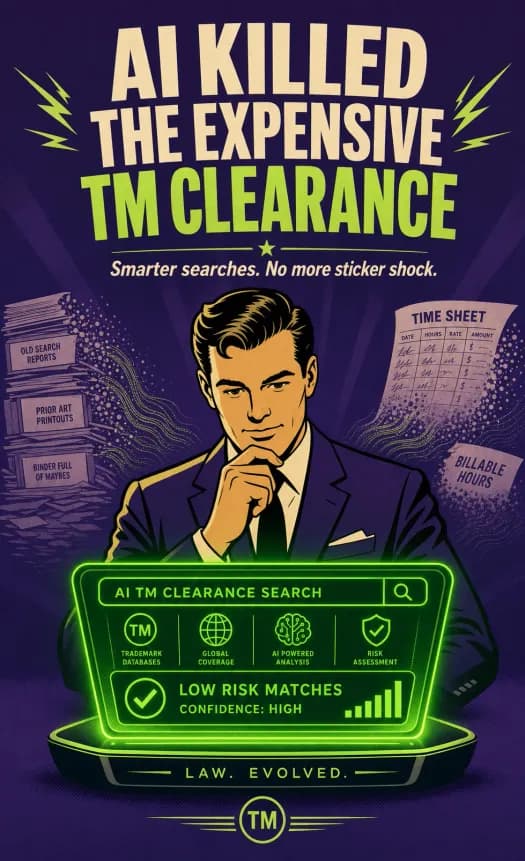
In-house departments and small to medium-sized firms live with the same brand-launch velocity the big players do, but without the same budget or bench strength. AI-powered trademark tools help close that gap by screening more registries, more variants, and more online use in a fraction of the time. Practitioners report that AI-enabled clearance can materially reduce search time while improving consistency in identifying phonetic, visual, and conceptual similarities across datasets.
For in-house counsel, that means you can internalize earlier-stage screening rather than sending everything out, preserving outside counsel spend for close calls and high-stakes names. For boutique and mid-sized firms, it means handling higher volumes and tighter timelines without proportionally increasing headcount, which is crucial for remaining competitive against larger IP shops.
What The Machine Is Actually Good At
Modern trademark search platforms spot patterns that humans struggle to consistently catch under time pressure. They can identify spelling variants, homophones, translations, and logo resemblances, and then prioritize results that statistically resemble real-world conflicts. Many also expand coverage beyond national registries to social media, app stores, domains, and marketplaces, which is increasingly important for consumer-facing brands.
For in-house teams, this translates into faster early "go/no-go" clarity, so you can give business partners directional guidance while a more formal search is still in motion. For small firms, it supports value-priced, fixed-fee clearance tiers in which AI handles the bulk of the initial sifting and attorneys focus on interpreting a smaller, higher-signal subset of hits.
Where Human Judgment Still Leads
No AI system can define your company's or client's risk tolerance, weigh competitive dynamics, or understand how central a particular mark is to a long-term brand strategy. Courts and regulators continue to treat trademark clearance and enforcement as fundamentally human professional work, and AI vendors themselves emphasize that their tools assist with search and monitoring rather than replace legal analysis. Guidance from agencies and bar groups likewise stresses that lawyers remain responsible for supervising AI outputs, checking citations, and safeguarding confidential information.
For in-house counsel, that means AI can inform, but never supplant, your advice to marketing, product, or executive leadership on whether a particular level of conflict risk is acceptable. For small and mid-sized firms, it means your differentiation still lives in nuanced counseling: assessing enforcement histories, negotiating coexistence, and suggesting fallback naming strategies when the first choice is too exposed.
Process Design: Keeping Counsel In Control
The real leverage comes when you design your clearance workflow: humans set the strategy, and AI executes within those guardrails. Best-practice guidance on AI governance in IP and branding consistently identifies two pillars: clear internal policies and documented review processes. On the front end, that includes defining which jurisdictions matter, how to scope related goods and services, and when to escalate from quick knock-out searches to full availability opinions.
CrossBeamIP is built around this human-first model. A structured intake forces in-house teams or outside counsel to articulate the strategy, keywords, search terms, and classes before any automated searching begins, so the software executes a plan you designed instead of using opaque, vendor-defined defaults. This aligns with broader recommendations that in-house legal and firms maintain control over AI configuration and ensure tools reflect their actual risk framework. For small firms in particular, templated questionnaires can standardize quality across partners and associates, so every search starts from the same disciplined playbook.
Evidence, Audit Trails, And Defensibility
Whether you sit in-house or in a firm, your clearance decision is only as defensible as the record behind it. IP and AI risk guidance consistently stresses the need to preserve underlying materials and be able to tie legal conclusions back to concrete sources. That matters in several familiar scenarios: a later rebrand dispute, M&A due diligence, an insurance inquiry, or an internal post-mortem when a conflict arises despite prior searching.
CrossBeamIP's approach, embedding live links from each reported hit back to the original registry entry or online source, directly supports that requirement. Instead of static PDFs or screenshots lacking context, your file shows exactly what was reviewed and how it appeared at the time, reinforcing that counsel exercised reasonable care given the information available. For in-house teams, it can make it easier to brief a new GC or external auditor; for firms, it can be a tangible deliverable that differentiates your clearance work from competitors that rely on opaque vendor reports.
A Practical Trust Model For AI Clearance
For in-house departments and small to mid-sized firms, the most realistic answer to "how far can you trust the machine?" is this:
- Trust AI to do more, faster: broad, multi-source searches; pattern recognition; ongoing monitoring and alerts.
- Do not trust AI to make the call: accept, reject, or proceed with a mitigation plan, which remains a lawyer's responsibility.
- Build workflows where humans define the search blueprint, AI executes at scale, and every reported risk is tethered to verifiable evidence.
Used this way, AI-assisted clearance becomes a force multiplier for lean legal teams: you move faster, you see more, and you still own the judgment.